Skip to content

THE SYSTEM

Take that week off. Nothing drops.

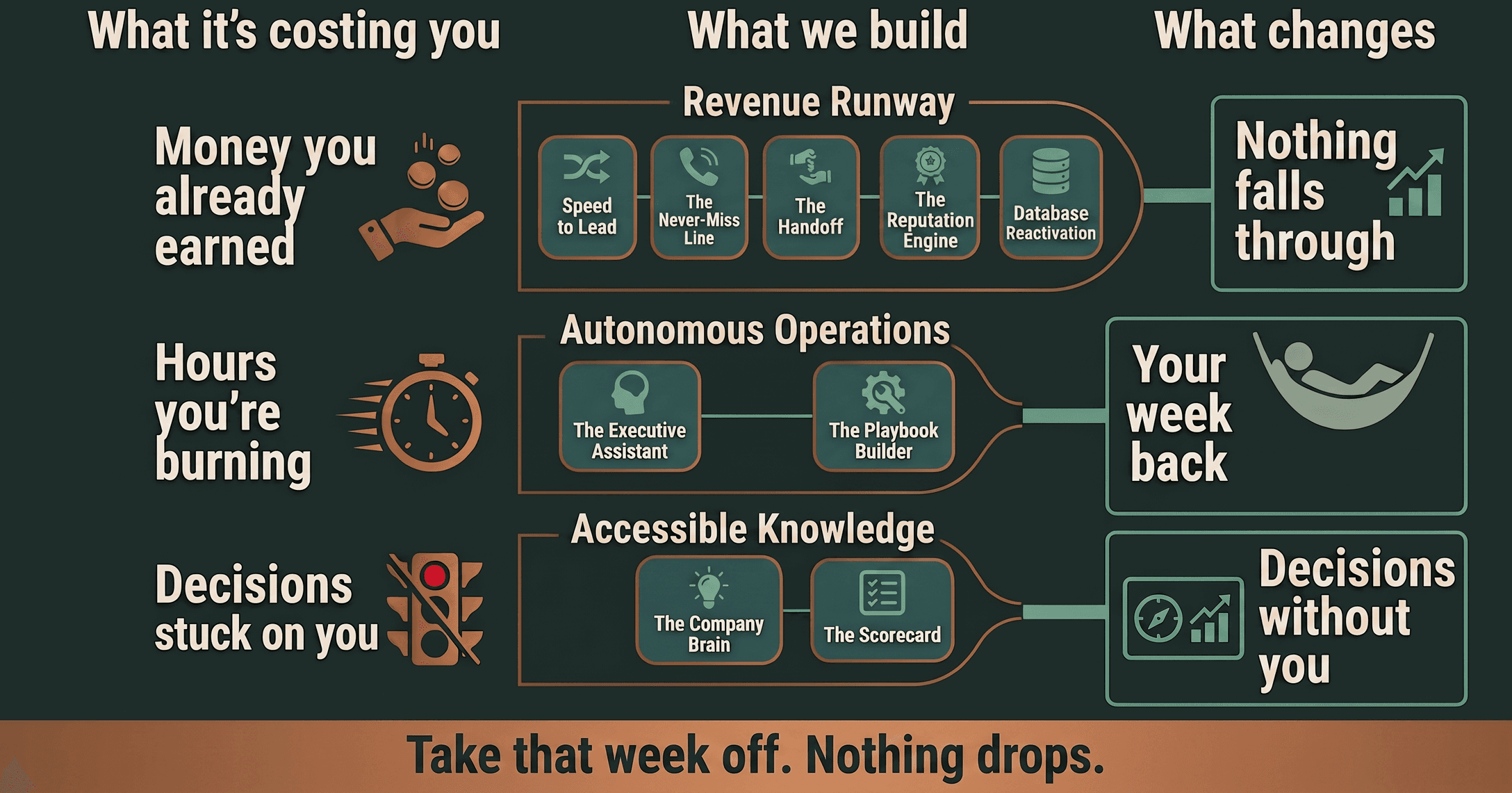
Nine tools. Three kinds of leak.

Every one of them gets built for your business, on your systems, with your process.

THE FOUR LEAKS

Nothing here is dramatic. No single failure big enough to notice on its own — which is exactly why it runs for years.

  1. LEAK 01

    Missed money

    You paid for that lead twice. Once to get it, once to lose it.

    It's 2:15 on a Tuesday. Both your people are on calls. The phone rings a fourth time and rolls to voicemail. The person on the other end doesn't leave one — they go back to the search results and call the next name down.

    What this looks like

    The quote you sent Thursday hasn't been followed up because the person who was going to do it got busy. The form fill from Saturday night sat until Monday morning, and by Monday morning they'd already hired someone.

    You will never know any of it happened. You'll just notice at the end of the month that the number was soft again, and wonder if you need to spend more on marketing.

  2. LEAK 02

    Clients leave

    Nothing went wrong. They just stopped calling.

    A client you did good work for eighteen months ago hasn't been back. Not because anything went wrong — nothing went wrong. Nobody asked them for a review while they were still happy about it. Nobody noticed when they went quiet. Nobody ever called to say hey, it's been a while.

    What this looks like

    Meanwhile the three people who were unhappy left reviews on their own, and those are the ones on your profile. The next person who searches for you reads those three and never calls at all.

    You're not losing clients. You're just not keeping them, and it costs the same.

  3. LEAK 03

    Your calendar

    It's Sunday night and you're building the schedule again.

    Ninety minutes on next week's staff schedule. Two hours on the weekly report. An hour chasing invoices that should have paid themselves. Seventy-five minutes turning the same quote into the same proposal. Another two hours pulling numbers into a deck for Thursday's meeting.

    What this looks like

    None of it is hard. None of it needed you specifically. All of it happened after your kids went to bed, because the day belonged to everybody else.

    That's a full day, every week. Call it four hundred hours a year — ten working weeks of work you'd never hire a person to do, and never got around to hiring a person to do.

  4. LEAK 04

    Team stuck on you

    Every answer in this company still routes through you.

    Your best tech texts you from a job site because he can't remember how you handle it. Your front desk asks the same pricing question a new hire asked in March — because the answer lives in your head, a Drive folder, an old email thread, and a binder nobody opens.

    • Gallup estimates that replacing one employee costs between one-half and two times their annual salary — and calls that a conservative figure.

      Gallup · US employers · 2019
    What this looks like

    So they ask you. And you answer, because it's faster than explaining where to look.

    Then someone quits, and everything they knew walks out the door with them. You train the replacement yourself. Again. And the good people who stayed can't tell you what winning looks like in their own job, because nobody ever wrote it down.

Not sure which one is yours? Six questions, two minutes, and you'll know.

Find your bottleneck

You don't need more people. You need a business that works when nobody's watching.

Hiring is the reflex, and it rarely fixes this. Another person is another place things fall through, another set of questions routed to you, another salary against the same leaking bucket.

Software is the other reflex, and it fails the same way. Most owners at this stage have already bought something — a CRM nobody updates, an automation that broke in March, an AI tool that impressed everyone for a week. The tool was never the problem. Dropped onto a process that's already broken, it just makes the broken process faster.

The businesses that break out of this don't add to the problem. They find the real constraint and close it. Then the tools go where they'll stick.

GROUP ONE

Money you already earned

Five tools that sit on the path a customer already walks. Nothing here finds you new demand — it stops you losing the demand you have.

The customer's path
  1. Inquiry

    The leak

    Sits in the inbox over the weekend

  2. Call / Connect

    The leak

    Rolls to voicemail when you're busy

  3. Onboard

    The leak

    The details fall on the floor

  4. Complete

    The leak

    Your happiest clients are silent

  5. Dormant

    The leak

    Revenue already in your CRM, forgotten

One path, five places it breaks. The tools attach to your business, not to the customer — nobody on the other end knows they're there.

SPEED TO LEAD

Speed to Lead

The first business to answer usually wins. It's rarely you.

Every inquiry from every source — the website form, the ad, the social message, the referral text — lands in one place and gets a real response in minutes, day or night. It offers times, books the appointment, and keeps following up until they answer or tell you to stop. Nothing sits in an inbox over a weekend.

You watch a form fill at 9pm on a Saturday turn into a booked appointment before you've read the notification.

Under the hood

Unified intake across all sources into one contact record. Response and booking workflows in your CRM. Multi-touch follow-up sequences with opt-out handling. Full attribution by source.

THE NEVER-MISS LINE

The Never-Miss Line

The call you didn't answer went to your competitor.

An employee who answers on the first ring, at 6pm on a Saturday, and never calls in sick. It picks up, finds out what they need, and routes them — new client to sales, existing client to their person, emergency to you. Everyone gets a notification with the transcript before they pick up the phone.

Your voicemail box stops filling up, and you can read every call that came in while you were with a client.

Under the hood

AI voice agent trained on your services, hours, and escalation rules. Intent triage and department routing. Live transfer with warm handoff. Transcript and summary written to the CRM contact record.

THE HANDOFF

The Handoff

You already paid to win them. Then the details fell on the floor.

Sold to onboarded to scheduled to delivered to confirmed, with nothing dropped in between. Intake collected once and never asked for twice. Appointments confirmed and reminded. Milestones and next steps triggered on their own instead of when someone remembers.

Your no-show rate moves, and nobody on your team says “I thought you were handling that.”

Under the hood

Onboarding pipeline with stage-gated automations. Structured intake feeding the client record. Multi-channel confirmation and reminder sequences. Task assignment and escalation on overdue steps.

THE REPUTATION ENGINE

The Reputation Engine

Your happiest clients are silent. Your three worst are on page one.

Every client gets asked for a review at the moment they're most pleased, not three weeks later. Reviews get responded to fast, good and bad. Short satisfaction surveys run alongside, so you see a client souring while you can still do something about it — and your best ones get collected as testimonials you actually own.

Review volume moves, and you find out which client was unhappy before they told anyone else.

Under the hood

Trigger-based review requests tied to delivery completion. Response drafting with human approval. Survey scoring written to the contact record with alerting on low scores. Testimonial capture with usage consent.

DATABASE REACTIVATION

Database Reactivation

The cheapest revenue in your business is already in your CRM.

Personalized outreach to the list you already own — clients who went quiet, quotes that never closed, inquiries from two years ago. It runs as campaigns you approve, not blasts. The same engine keeps your current clients warm with check-ins and offers, so the list stops going cold in the first place.

A campaign to a segment you'd written off produces conversations, and you can see exactly who opened, replied, and booked.

Under the hood

List segmentation by recency, value, and service history. Personalized multi-channel sequences generated per segment. Reply detection with routing to a human. Suppression and compliance handling. Per-campaign revenue attribution.

GROUP TWO

Hours you're burning

Work a machine should be doing, done by a machine.

Five examples. Your list will be different, and it will be longer.

Work that repeats every week

Mon
90 min
The staff schedule
Tue
60 min
Invoicing and chasing payment
Wed
120 min
The weekly report
Thu
75 min
Quotes and proposals
Fri
135 min
Meeting prep and slide decks

The system does all of it

8 hours — one full day, back on your calendar.

What would you do with a full day back every week?

THE EXECUTIVE ASSISTANT

The Executive Assistant

Your job should be reviewing the work, not producing it.

Trained on your specific role and your specific workflow. The Monday report, the staff schedule, the board deck, the spreadsheet you rebuild every week — assembled and waiting for you. You read it, correct what's wrong, and send it. The corrections make the next one better.

One recurring task you've done manually for years shows up finished, and you spend fifteen minutes on it instead of ninety.

Under the hood

Workflow mapping session per task. Document and data pipelines into templated outputs. Human-in-the-loop review before anything leaves the building. Feedback captured back into the task's instructions.

THE PLAYBOOK BUILDER

The Playbook Builder

Everything you know is documented in exactly one place: your head.

You do the job once while it records — a call, a screen share, a walkthrough. It comes back as a written SOP, a checklist, and a training module for the next hire. Documentation stops being the project nobody finishes and becomes something that happens while you work.

A process you've never written down exists as a document your team can follow without you.

Under the hood

Capture from recordings, screen sessions, and existing scattered docs. Structured SOP generation against a consistent template. Versioning with owner approval. Published straight into the Company Brain so it's answerable, not just filed.

GROUP THREE

Decisions stuck on you

Answers and numbers that currently only live in your head.

The Playbook Builder writes what you know into the Brain. The Brain tells it what's still missing — it knows which questions it couldn't answer, and that list is your documentation backlog. The Scorecard reports the numbers up; the Brain defines what the targets should be. The Assistant learns how you like the work done, and every correction teaches it. And anyone on your team, in any seat, can ask and get an answer they're allowed to see.

The Company BrainEverything the business knows
  • CaptureThe Playbook Builder
  • MeasureThe Scorecard
  • ExecutiveThe Assistant
  • Every SeatYour team

THE COMPANY BRAIN

The Company Brain

Your team asks you because asking you is faster than looking.

One place that holds what your business knows — SOPs, pricing, policies, past decisions, the answer to the question that gets asked every March. Anyone can ask it in plain language and get the answer their role is allowed to see. It learns as new material lands, so it doesn't rot the way the shared drive did.

Someone gets an answer without texting you, and you notice you weren't interrupted.

Under the hood

Retrieval over your own documents with role-based permissions. Source citation on every answer so it can be verified. Ingestion from your existing drive and CRM. Refusal to answer rather than guess when the source isn't there. Your data isolated from the model layer.

THE SCORECARD

The Scorecard

You can feel how the month went. You can't see it until it's over.

The numbers that actually run your business, assembled automatically and sitting on one screen — plus in your inbox every Monday. Underneath the company view, each role gets its own scorecard, so every person can tell you what winning looks like in their seat without asking.

You open one link instead of three systems, and someone on your team knows their number without you telling them.

Under the hood

Connectors into your CRM, financial, and operational systems. Defined metrics with owners and targets. Scheduled delivery. Per-role views with permissioned access.

WHERE TOOLS DON'T HELP

Not every bottleneck is a tooling problem.

If you've grown and stalled, or you're busy and not profitable, tools help at the edges — but the core of it is judgment. Pricing, structure, the hard calls on people. No system builds its way out of that. It's what the Operator's Assessment is for, and it's what we do in the seat. We'll tell you that before you buy anything.

This works. But not for everyone.

It's for you if:

  • You're doing $1M+ and you've hit a ceiling.
  • You see AI as opportunity, not a threat.
  • You're ready to change how you operate, not just hear that you're doing fine.
  • You want a partner who builds, not an advisor who bills.

It's not for you if:

  • You want the cheapest possible fix and nothing more.
  • You want validation, not change.
  • You want someone to hold your hand instead of hand you the business back.
  • You're looking for a report to put on a shelf.

HOW YOU GET IT

You don't buy the toolbox. You buy the diagnosis first.

Nobody should spend money on a build before they know which leak is actually costing them. So this starts with finding out — and if the answer is that you don't need us, we'll say so.

  1. STEP 01

    The call

    No cost

    30 minutes. No deck.

    You tell us what's breaking. We ask questions until we understand how the business actually runs, not how the org chart says it does. At the end we tell you what we think the constraint is and whether it's worth paying us to look harder. Some of these calls end with a recommendation and no invoice.

  2. STEP 02

    The Operator's Assessment

    $2,500

    Two weeks.

    We go into the business properly — your systems, your numbers, your people, the work as it's actually done. You get back a written map of where money and hours are leaking, ranked by what it's costing you, with a build plan against the top three. It's yours whether or not you hire us for the build.

    If the Operator's Assessment doesn't identify at least $25,000 in annualized savings, recoverable revenue, or time going to work that doesn't need you, you don't pay — and you keep the custom plan we built.

    Subject to participation requirements. See the Assessment Agreement for full details.

    What this involves
    • We read the whole business — sales, delivery, people, money, tools — as one system. The constraint is rarely where the pain is loudest.

    What we need from you: Access, about four hours of your own time across two weeks, and short conversations with a few of your key people.

  3. STEP 03

    The build

    $10,000

    Fixed scope. Fixed price. Named date.

    We pick from the toolbox based on what the Assessment found — usually one or two to start, not nine. You know the price and the delivery date before it begins. It gets built on your systems, with your process, and your team gets trained on it.

    What this involves
    • We build it ourselves. No handoff to a junior team, no offshore shop, no spec-and-good-luck.
    • Your team is trained to run it without us. If the fix depends on us forever, it isn't a fix.

    What we need from you: One person who knows how the work really happens, and a decision when we ask for one.

  4. STEP 04

    Staying on

    Two ways, depending on what you need next.

    Build & Optimize

    $2,500–$5,000/month

    We keep building. New systems as the business outgrows the old ones, the dashboards and SOPs that hold it together, in 90-day cycles. You're still the one running the company.

    Fractional COO

    $5,000–$8,000/month

    We take the seat. Delegated authority over the operations we agree on — not your finances — and an operator in the room for the calls that matter. For when you don't need more built. You need someone running it.

    They stack. Most owners start with one.

    We agree up front on the numbers that should move. We review them every 90 days. If they're not moving, you shouldn't be paying us.

You can stop at any rung. The Assessment isn't a trap that only pays off if you buy the build. The build isn't a trap that only works if you retain us. Each thing stands on its own, and the whole point is that what we build keeps running after we're gone.

START HERE

Find out which of these you actually need.

Thirty minutes on a call. We'll tell you where the money and the hours are leaking, and whether we're the right people to fix it.

We've built and run operations through a company's growth from a handful of people to 800, and an exit north of a hundred million. The tools above are how we'd do it again with the software that exists now.

6 questions, and you'll know which leak is costing you most right now.